

When Termites Are Hidden Deep Inside a Structure, Specialized Treatment May Be Necessary
Certain wood-destroying insect infestations cannot be effectively addressed by simply applying a product to an exposed area of damaged wood.
Drywood termites, for example, can establish colonies entirely within wooden structural components without maintaining a connection to the soil. Their activity may be distributed through wall framing, roof timbers, attic spaces, and other locations that are difficult to access directly.
When an infestation is extensive or spread throughout multiple parts of a building, structural fumigation may be an appropriate treatment option.
Dave’s & Kevin’s Termite and Pest Control provides professional structural fumigation services for qualifying properties throughout Lafayette and the surrounding Acadiana communities.
Structural fumigation uses a specially registered fumigant within a carefully enclosed building to reach susceptible pests in otherwise difficult-to-access locations. Unlike localized applications, the treatment is designed to penetrate spaces throughout the enclosed structure.
Fumigation is a specialized procedure requiring detailed preparation, strict safety measures, professional equipment, and controlled reentry procedures.
Our team evaluates the infestation before recommending this service, explains the process, and guides property owners through the required preparations.
Contact Dave’s & Kevin’s for a Structural Fumigation Evaluation.


Get Your Free Pest Control Quote
Tell us what you’re dealing with and a member of the Dave’s and Kevin’s team will help you determine the right solution for your home.
Specialized Whole-Structure Treatment With Professional Oversight
Structural fumigation is a comprehensive treatment method for certain difficult-to-reach wood-destroying insect infestations. Dave’s & Kevin’s provides professional evaluations, detailed preparation instructions, controlled treatment procedures, and required safety verification before a property is cleared for reoccupancy.
OUR FIVE-STEP STRUCTURAL FUMIGATION PROCESS

Diagnose
We inspect the property and evaluate the type, location, and extent of wood-destroying insect activity to determine whether structural fumigation is appropriate.


Prepare
Our team develops a treatment plan and provides detailed instructions regarding occupancy, belongings, food, plants, pets, and other preparations required for the building.


Secure
We establish the necessary enclosure and safety controls, secure the treatment area, and prepare the structure for professional fumigant application.


Fumigate
Qualified personnel perform the treatment using approved fumigation procedures, equipment, and product requirements appropriate to the infestation.


Clear
After treatment, the structure is aerated and tested according to applicable clearance procedures. Reentry is permitted only after the property has been officially cleared.

Schedule Your Termite Inspection Today!
Termites can cause significant damage long before you notice the signs. Don’t wait until it’s too late! Schedule a professional termite inspection today to identify potential activity, protect your property, and gain peace of mind.
Understanding When Structural Fumigation Is the Right Termite Treatment
Some Termite Infestations Require a Different Approach
Not all termites behave the same way, and this distinction is important when choosing a treatment.
Subterranean termites usually maintain a relationship with the soil, although certain species can establish aboveground nests under favorable moisture conditions. These infestations are generally addressed through colony-focused treatments, soil applications, or other appropriate methods.
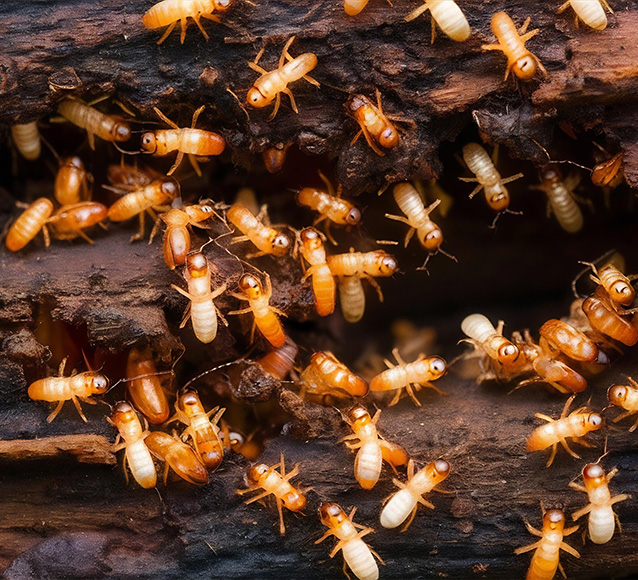
Drywood termites behave differently. They can live entirely inside dry wooden materials and may establish separate colonies throughout a building.
When drywood termites are distributed across multiple inaccessible locations, treating individual visible areas may leave other parts of the infestation unaffected.
Structural fumigation may be recommended when the pest species, infestation extent, and building conditions justify treating the entire enclosed structure.
How Whole-Structure Fumigation Works
During structural fumigation, the building is enclosed using specialized materials designed to contain the fumigant during treatment.
A registered fumigant is introduced under controlled conditions and allowed to distribute through the enclosed space. The treatment is designed to reach susceptible pests within structural voids and wooden components that cannot easily be accessed by conventional applications.
Because fumigants are hazardous and require precise handling, only appropriately qualified professionals should perform these procedures.
The application process follows the fumigant’s label requirements and applicable regulations governing treatment, enclosure integrity, exposure periods, and clearance.
Preparation Is a Critical Part of the Process
A successful fumigation project depends on careful coordination with the property owner.
Before treatment, occupants must prepare the building according to the instructions provided by the fumigation team. This may include removing people, pets, and plants; addressing food and medication storage; and making arrangements for temporary accommodations.
The preparation instructions vary depending on the product, building, and treatment conditions.
Dave’s & Kevin’s explains these requirements in advance so homeowners understand their responsibilities and can make the necessary arrangements before the scheduled service.
Clearance and Reoccupancy Must Be Verified
After the fumigation exposure period is complete, the building must undergo an approved aeration process.
Professional personnel use appropriate monitoring equipment to verify that fumigant concentrations have reached the required clearance level before occupants are permitted to return.
Homeowners must never enter an enclosed or restricted structure until the authorized fumigation professional confirms that reentry is permitted.
The treatment also does not repair existing structural damage or create a lasting insecticide barrier against future infestations. These are separate concerns that may require additional services or preventive measures.
Why Choose Dave’s and Kevin’s Pest Control?
When you choose Dave’s and Kevin’s, you’re choosing a local pest control company that has been protecting Acadiana homes for more than six decades.





Local & Family Owned
We’re proud to be a local company with deep roots in the communities we serve.

Serving Acadiana Since 1962
More than 60 years of experience means we understand the pests, climate, and conditions unique to South Louisiana.

Board Certified Entomologist
Our team has access to advanced expertise in insect biology, pest behavior, identification, and effective pest management.

Integrated Pest Management
We use IPM principles to understand why pests are present and develop targeted strategies for effective, long-term control.

Fully Trained & Licensed Technicians
Your property is serviced by knowledgeable pest professionals trained to identify problems and recommend the appropriate solution.

100% Satisfaction Guaranteed
We stand behind our work and make customer satisfaction a priority from your first consultation through ongoing service.

Free Consultations & Estimates
Have a pest problem? Start with a free consultation and let our team help determine the right treatment for your property.
Local & Family Owned
We’re proud to be a local company with deep roots in the communities we serve.
Serving Acadiana Since 1962
More than 60 years of experience means we understand the pests, climate, and conditions unique to South Louisiana.
Board Certified Entomologist
Our team has access to advanced expertise in insect biology, pest behavior, identification, and effective pest management.
Integrated Pest Management
We use IPM principles to understand why pests are present and develop targeted strategies for effective, long-term control.
Fully Trained & Licensed Technicians
Your property is serviced by knowledgeable pest professionals trained to identify problems and recommend the appropriate solution.
100% Satisfaction Guaranteed
We stand behind our work and make customer satisfaction a priority from your first consultation through ongoing service.
Free Consultations & Estimates
Have a pest problem? Start with a free consultation and let our team help determine the right treatment for your property.
Professional Structural Fumigation in Lafayette and Acadiana
Professional Structural Fumigation in Lafayette and Acadiana
Dave’s & Kevin’s provides structural fumigation evaluations and services for qualifying properties throughout Lafayette, Youngsville, Broussard, Scott, Carencro, New Iberia, Abbeville, St. Martinville, Opelousas, and surrounding communities.
We help property owners determine whether whole-structure treatment is appropriate and explain the necessary preparation and treatment procedures.
FREQUENTLY ASKED QUESTIONS ABOUT STRUCTURAL FUMIGATION
What types of termite infestations may require structural fumigation?
Structural fumigation is most commonly considered for certain drywood termite infestations, particularly when colonies are spread across multiple locations inside a building or exist in areas that cannot be treated adequately through localized methods.
Drywood termites live within wooden materials and do not require the same soil connection as subterranean termites. Consequently, individual colonies may remain concealed in framing, roof structures, or other enclosed wood.
An inspection is necessary to determine the termite species and extent of the infestation. Fumigation is not automatically required simply because termite damage appears extensive.
Will structural fumigation eliminate Formosan subterranean termites?
Structural fumigation is generally not the preferred standalone method for controlling Formosan subterranean termites. Although fumigant exposure can kill termites inside the treated enclosure, subterranean colonies may survive in the soil or in locations outside the fumigated area.
This means the building could remain vulnerable to additional termite entry after the treatment.
Formosan termite management more commonly involves methods designed to address subterranean colonies and their access to the structure, such as appropriate baiting or liquid soil treatments.
Dave’s & Kevin’s identifies the termite species before recommending a treatment, ensuring that homeowners understand which methods are suitable for the problem.
What must homeowners remove or prepare before structural fumigation?
Preparation requirements depend on the fumigant and the conditions of the treatment. Occupants, pets, and houseplants must be removed from the structure, and special handling may be required for food, medications, and other items.
Certain products or materials may need to be removed or protected according to the fumigant label and the instructions provided by the treatment team.
Homeowners may also need to arrange access to the property, secure valuables, and coordinate temporary accommodations.
Dave’s & Kevin’s provides specific preparation instructions before the scheduled treatment. Following these directions is essential for a properly organized and safe fumigation project.
How long will my family need to stay away from the house?
The period of temporary relocation depends on the size and construction of the building, treatment conditions, fumigant requirements, exposure period, and the time needed for aeration and clearance.
Homeowners should not assume that every structural fumigation can be completed within a standard or guaranteed number of hours.
Dave’s & Kevin’s explains the anticipated schedule during treatment planning. However, occupants may return only after the required clearance testing confirms that the property meets the applicable reentry standard.
Safety verification, rather than a predetermined clock time, determines when the structure can be occupied again.
Is it safe to return home after professional fumigation?
A professionally fumigated structure must be properly aerated and verified to meet the required clearance conditions before reoccupancy.
The fumigation team uses appropriate monitoring instruments and follows the applicable procedures to determine when the structure can be released.
Because fumigants can be extremely hazardous, nobody should enter the restricted building during treatment or aeration without authorization and appropriate protection.
Once the designated professional confirms clearance and authorizes reentry, occupants may return according to the instructions provided. Homeowners should never remove warning notices or attempt to enter the building early.
Does structural fumigation prevent future termite infestations or repair existing damage?
No. Structural fumigation is designed to eliminate susceptible pests present in the treated space during the fumigation process. It does not leave a residual treatment behind to prevent new insects from entering later.
It also does not restore wood that has already been damaged. Structural repairs, when necessary, must be addressed separately by appropriately qualified professionals.
After fumigation, homeowners should discuss relevant preventive measures and periodic inspections. The appropriate follow-up strategy depends on the pest involved and the building’s conditions.
Dave’s & Kevin’s can help determine whether additional termite protection services are recommended after the fumigation is completed.
Get Professional Help for Difficult Wood-Destroying Insect Infestations
When termites are concealed in inaccessible wooden structures, an accurate diagnosis is essential to selecting the proper treatment.
Dave’s & Kevin’s can evaluate your property and explain whether structural fumigation is the right solution.
Schedule Your Structural Fumigation Evaluation Today!
Call (337) 330-2692 to speak with our termite professionals.